


Un pueblo sin murales..


Mural's Citation
Carlos Salazar and Felipe Martinez, 1973; restored by Juan Pineda and Horacio Quintanilla, 2005. 1979 Columbia Road, NW. Sponsors: Original, Centro De Arte; Restoration, Mayor’s Office on Latino Affairs and Adams Morgan Advisory Neighborhood Commission.
Photo by Lou Panarale.
Mural's Story
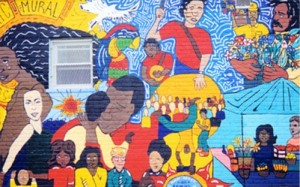
"Un pueblo sin murales. . . ." Carlos Salozar and Felipe Martinez, 1973; restored by Juan Pineda and Horacio Quinanilla, 2005. 1979 Columbia Road, NW. Original, exterior paint on brick; restoration, latex and aerosol paint. (Ward 1, Adams Morgan). Sponsors: Original, Centro de Arte; Restoration, Mayor’s Office on Latino Affairs and Adams Morgan Advisory Neighborhood Commission (ANC).
Un pueblo sin murales (“A people without murals,” also known as the Adams Morgan Mural or the Riggs Mural, is the oldest piece remaining in place from the beginning phase of the contemporary mural cycle in Washington. The work was designed and executed by Carlos Salozar and Filipe Martinez, Chilean immigrants who joined thousands of their compatriots in fleeing the repressive Pinochet regime in the 1970s. The two co-founded Centro de Arte, a nonprofit cultural organization seeking to promote Latino artistic expression and community.
The crowded surface conveys the frenetic and confusing Latino subculture of the period, a time when thousands of immigrants from Latino countries converged on the neighborhood to join relatives and seek political asylum. At the top of the mural a small Washington Monument establishes the setting, but the action clearly takes place far from the Federal City.
According to Carlos Arrien, a local artist and arts administrator who worked on the mural as a youth, the ghost-like figure with the center eye in the upper left represents the omniscient, oppressive presence of the government (perhaps immigration authorities). The upper right contains monstrous figures gathered around a table, playing monopoly under an unshaded light reminiscent of Guernica. The image symbolizes the real estate speculation that decimated affordable housing in the area, with bankers financing the conversion of historic apartment buildings into condominiums.
The painting is far from universally bleak, however: Below, cubist-style figures work with paints—perhaps representing the muralists themselves. The bottom foreground, from left to right, shows a multi-racial group, a dancing couple of indeterminate gender, and a lively band.
A small painting adjacent to the mural carries the caption that expresses the work’s theme: Un pueblo sin murals es un pueblo desmuralizdo (“A people without murals are a demuralized people.” In both English and Spanish, “demuralized” is a pun on “demoralized,” suggesting that the rise of public art expressing Latino life in Adams Morgan helped draw immigrants from many different homelands together into a single community.
Centro de Arte completed six murals over several years, picking up on the energy that was sparked by Chicago’s protest mural, the Wall of Respect (1967); the movement spread to Latino communities and causes, linking the Civil Rights struggle of African Americans to issues taken up by the United Farm Workers under the leadership of Cesar Chevez and others. Latino art has continued to be an important subgenre in the Washington mural cycle, with the Latin American Youth Center in Columbia Heights providing sponsorship and direction. The much-faded Un pueblo sin murals, a neighborhood icon, was restored with local funding in 2005.
related projects
-
 Learning through arts and community service
-
 Chuck Brown tribute in Parkview
-
 Communication in Columbia Heights
-
 This education themed mural was painted in the inaugural year of MuralsDC, a citywide anti-graffiti initiative.
-
 This mural near Howard relates seasons of the year with seasons of life, a theme suggested by the building owner.
-
 Daughter of Oshun in the World. (Ward 1; front and side of Hooked Seafood Restaurant.) 3200 Georgia Ave., NW. 25’ x 15’; acrylic on wood. Joel Bergner, 2008. Sponsored by DC Commission on the Arts and Humanities.
-
 Iconic heroes in a colorful new context at the refurbished Parkview Recreation Center in Northwest.
-
 Vignettes represent Columbia Heights, past and present.
-
 Many layers of Latino identity in Columbia Heights.
-
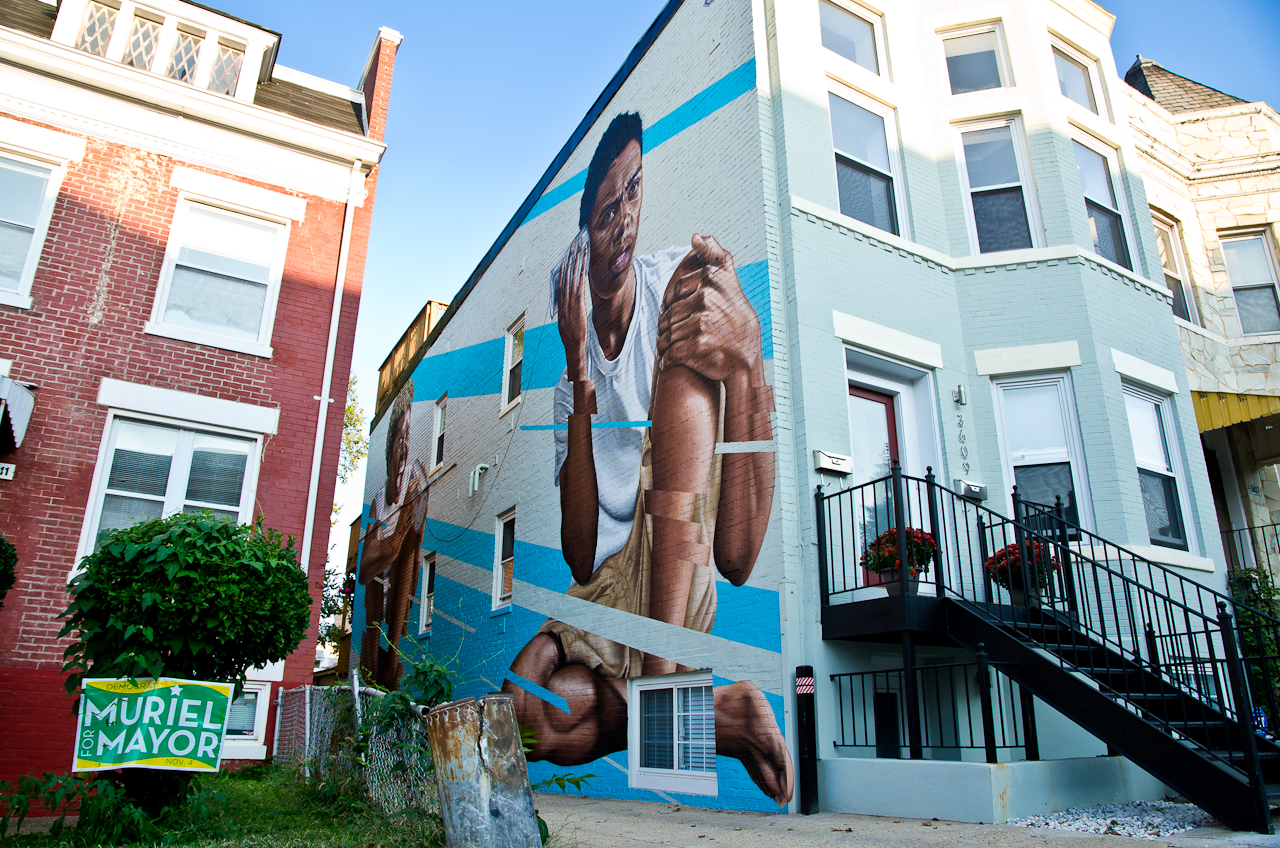
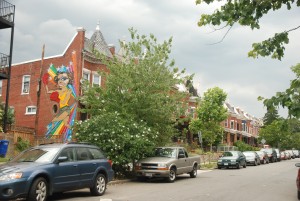 Boxer Girl (2009), Lisa Marie Thalhammer. 1st and W Sts., N.W., private home, alley side. enamel on brick (Ward 1, Bloomingdale). Sponsor: D.C. Commission on the Arts and Humanities.
-
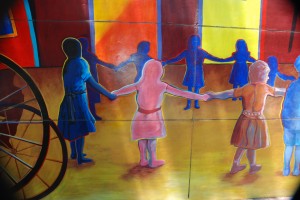 Children learn the colorful history of their Shaw neighborhood through this playground backdrop.
-
 The faded but still proud mural on the wall of the PEPCO substation adjacent to the Marie Reed Community Learning Center was created as a summer youth project under the supervision of the late Allen Carter (“Big Al”), and Ligia Becker, a Columbian artist with ties to Centro de Arte.
-
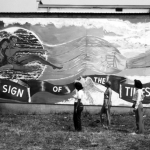 Creator’s Gift was the first public mural “east of the river,” painted on the wall of a bakery at Division and Nannie Helen Burroughs Aves., N.E.
-
 The mural impetus came to fruition at Howard under the leadership of Jeff Donaldson, Ph.D., the artist and scholar who joined the Department of Fine Arts in 1969.
-
 This mural at Howard University highlights the connection between traditional African art and modernism.
-
 Washington’s renowned native son and jazz artist looks down on the neighborhood where he grew up.